
A Breath of Fresh Air for Kids with Asthma
Updated: May 5
A new study at Royal Victoria Regional Health Centre (RVH) is changing how childhood asthma is understood and managed.
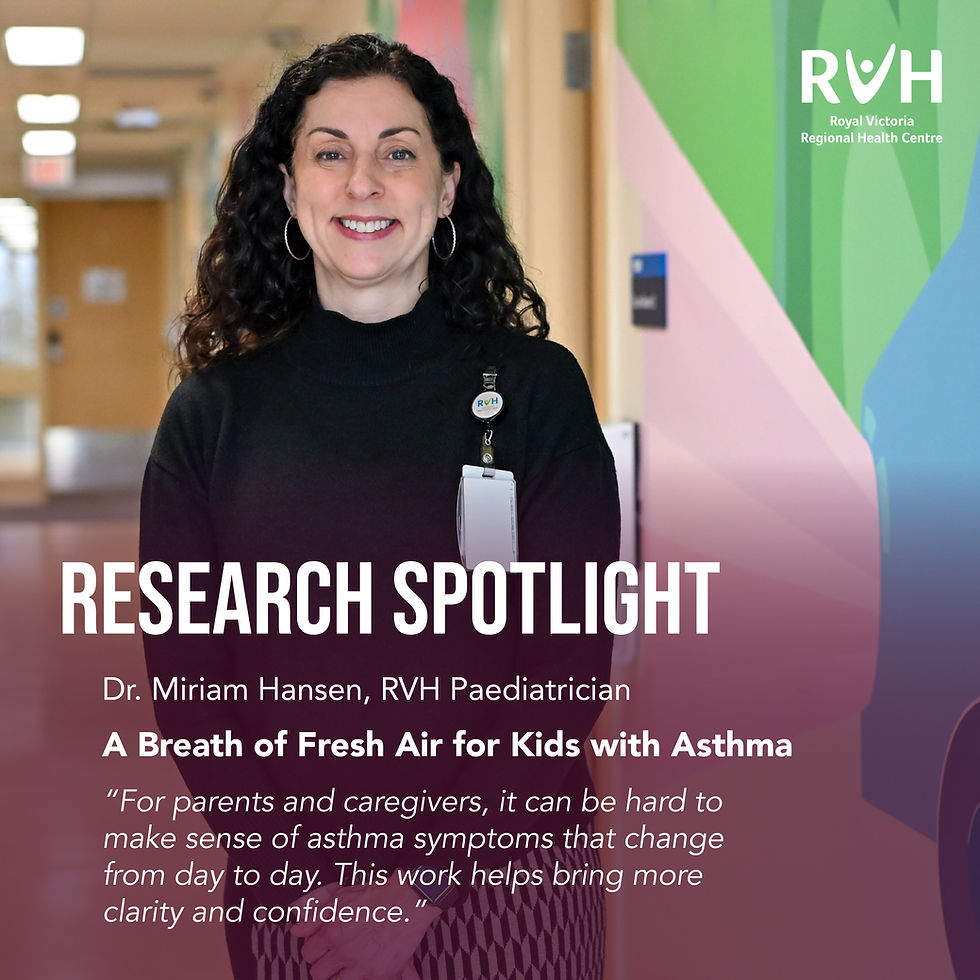
For many families, asthma is part of everyday life. Affecting up to one in five children in Canada, it is the most common chronic childhood condition. For parents and caregivers of preschoolers, it can be especially challenging, with symptoms like coughing and wheezing coming and going without warning.
At RVH’s Paediatric Asthma Clinic, paediatrician and lead investigator Dr. Miriam Hansen and the care team are exploring a new approach that combines real-time symptom tracking with advanced breathing technology to better understand what children are experiencing.
Diagnosing asthma in young children has long been difficult. Unlike older children and adults, most preschoolers cannot complete standard breathing tests that require a deep breath followed by a forceful exhale.
Instead, care teams rely on what parents and caregivers observe at home, including how often a child coughs or wheezes, whether symptoms interrupt sleep, whether they use inhalers, and whether care is needed in urgent or emergency settings.
But recalling weeks or months of symptoms is not always easy, especially when asthma can change from day to day. A child may have several quiet weeks, followed by a sudden stretch of coughing, wheezing, missed sleep or visits to a doctor.
“Right now, we’re asking families and caregivers to remember several months’ worth of symptoms,” said Dr. Hansen. “Even for the most engaged caregivers, that’s incredibly hard to do accurately.”
To help reduce that uncertainty, the study uses a simple app-based diary with weekly reminders, allowing parents and caregivers to track symptoms in real time and share what is happening between clinic visits. This approach helps capture a more accurate picture of symptoms over time.
“What we’re trying to do is reduce the guesswork,” said Dr. Hansen. “Parents and caregivers know their children better than anyone. The diary gives them a simple way to share what is happening week by week, so we can better understand each child’s asthma symptoms and make more informed decisions together.”
Early results are encouraging. Of the first 45 families enrolled, 90% have used the diary at least once, and many continued throughout the 16-week study. Families and caregivers completed about two-thirds of the weekly check-ins, suggesting the approach fits into busy routines while providing valuable insight for care teams.
The study also uses a breathing test called oscillometry, which measures how air moves through the lungs while a child breathes normally. This approach is particularly helpful for young children and can detect changes in the small airways that are harder to capture through observation alone.
“The diary helps us understand what families and caregivers are noticing between visits, while oscillometry helps us better understand what is happening in the lungs at the clinic,” said Dr. Hansen. “Together, they may give us a clearer picture of a child’s asthma than either one alone.”
Combined, these tools offer a more complete picture of a child’s asthma, bringing together what parents and caregivers are seeing at home with what care teams can measure during clinic visits.
By bringing these insights together, the team aims to diagnose asthma more precisely, monitor symptoms more closely and tailor treatment in a way that better reflects each child’s day-to-day experience.
For families, parents and caregivers, that can mean fewer unanswered questions and a clearer path forward. For the team at RVH, it is another example of how research can start with a practical problem and lead to solutions that make a real difference in care close to home.


