Research Spotlight: Gathering Evidence to Improve Blood Cancer Treatment for Older Adults
For Dr. Rouslan Kotchetkov, some of the most important research questions begin with the patients he sees in his clinical practice.
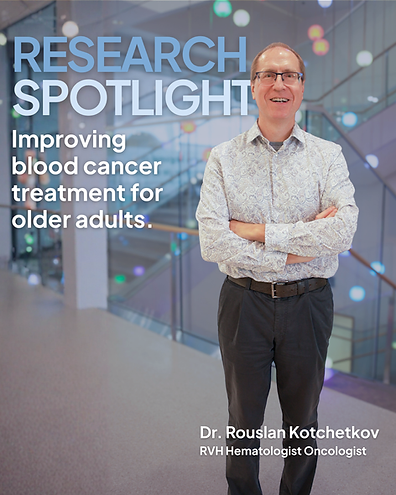
As a hematologist and cancer researcher at Royal Victoria Regional Health Centre (RVH), Dr. Kotchetkov cares for patients of all ages with blood cancer through the Hudson Regional Cancer Centre (HRCC).
Blood cancer is a broad term for any cancer affecting cells in your blood, bone marrow or lymphatic system, affecting how the body produces healthy blood cells and fights infections. These cancers make up 10 per cent of all cancer diagnoses in Canada, accounting for more than 20,000 new cases each year.
Research is essential to improving care for people diagnosed with blood cancer. Older adults, however, are often excluded from clinical trials because they are more likely to have other health factors that affect their eligibility. While this consideration is important for a trial’s safety and efficacy, it often means older or medically complex patients seen in routine clinical practice are less likely to be represented in research.
This is what drives Dr. Kotchetkov to gather and share new evidence about older adults and how they respond to different treatments. To help address this gap in the research, he began reviewing real-world patient data to investigate the effectiveness and safety of several different blood cancer treatments in older adult patients.
“Every patient presents a unique set of circumstances, and those complexities are often more pronounced in older adults,” says Dr. Kotchetkov. “Comparing the real-world outcomes of treatments across age groups helps clinicians make more informed, evidence-based decisions in their own practices."
Dr. Kotchetkov recently led a study investigating azacitidine, a drug often used to treat patients with Myelodysplastic Syndromes, a group of disorders that affect the bone marrow’s ability to produce healthy blood cells. While azacitidine is considered standard treatment for higher-risk myelodysplastic syndromes, there is limited evidence for how older patients respond and tolerate the treatment.
Alongside his team, Dr. Kotchetkov analyzed 105 cases from HRCC patients diagnosed with higher-risk myelodysplastic syndromes, and who received azacitidine as their initial treatment. The researchers compared patients aged 75 years and older with those younger than 75 years old, looking at how the treatment was administered, its safety and its effectiveness.
The results were encouraging, showing that older age alone does not mean patients respond less favourably to treatment or require a lower dose. Nearly all patients aged 75 and older received the full dose of azacitidine, and 96 per cent achieved disease control, meaning their disease either improved or did not worsen with treatment, a rate similar to that of the 93 per cent of patients younger than 75.
These findings are one example of how Dr. Kotchetkov uses clinical research to address questions that arise in his day-to-day practice and help ensure patients receive the best care, closer to home. With the encouragement, mentorship and autonomy he has found at the RVH Research Institute, he has been able to contribute to more than 70 studies like this one, addressing gaps in clinical evidence and generating knowledge that can help improve patient care.
“The freedom I’m afforded at RVH to work with patients, do research and blend the two allows me to answer ongoing clinical questions,” Dr. Kotchetkov says. “Here, my research team and I can lead the way and fill gaps in knowledge. As soon as I notice a place where care can be improved, I’m able to begin looking for answers and solutions and improve care for our patients.”
By asking questions others may not have, Dr. Kotchetkov has become an expert in many conditions and treatments that impact people’s lives worldwide. His expertise has led to opportunities to share his knowledge with doctors and researchers internationally, whether through collaboration, speaking engagements or discussion with colleagues seeking his perspective.
While his research reaches far beyond Simcoe Muskoka, its inspiration remains close to home. Dr. Kotchetkov continues to care for patients at RVH, turning questions from his practice into research that helps improve cancer treatment all around the world.
Learn more about Dr. Kotchetkov’s research here: Azacitidine Is Well-Tolerated and Is Associated with High Response Rate in Elderly Patients with Higher-Risk Myelodysplastic Syndromes: A Single Center Observational Study